Short sales, South Placer market trends, mortgage rates, ranch property and three featured homes.ALEX DYER | REAL ESTATEPLACER & SACRAMENTO COUNTIES · SEPTEMBER 24, 2026This week's market

Dated: January 23 2023
Views: 98
The Sacramento Business Review's forecast shows uncertainty for the year ahead.
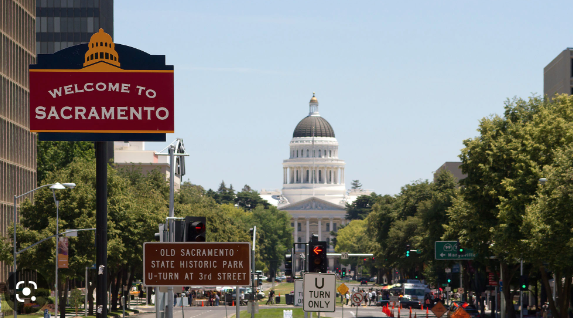
While parts of it are still recovering from the Covid-19 pandemic and other disruptions, others are in a decline that has economists talking about a possible recession on the horizon.
This is from our content partners at the Sac Business Journel.
The coming year will determine whether the region is in for a recession or a soft landing from some of the extreme highs and lows over the last few years, said Sanjay Varshney, chief economist for the Sacramento Business Review.
“2022 definitely played out the way we thought it was going to play out,” Varshney said. “2023 is going to be interesting because we have some dynamics playing in the background that could take us either way.”
Varshney is a finance professor at California State University Sacramento, and founder and principal at Goldenstone Wealth Management in El Dorado Hills. He leads the 21-person team of local experts in finance, real estate, health care and banking, and professors from Sacramento State who write the Business Review’s biannual economic forecast, which was discussed this week in an event at Sacramento State, presented by the Business Journal.
Last year the main headline was inflation — last summer inflation reached 9.1%, the highest it’s been in the last four decades.
That was largely driven, Varshney said, by supply chain disruptions, which were exacerbated by Russia’s invasion of Ukraine, and excess liquidity in capital markets.
“I think those forces are now unwinding in 2023,” Varshney said.
The Federal Reserve raised interest rates, and the supply chain is coming back into sync. As of December, inflation had fallen to 6.5%.
“We have seen the economy slow down in multiple ways,” Varshney said. “We have seen the labor market change dramatically.”
Rising interest rates have also helped douse the roaring Sacramento housing market, which during the pandemic was among the fastest-rising in the country.
Sanjay Varshney is chief economist for the Sacramento Business Review.
DENNIS MCCOY | SACRAMENTO BUSINESS JOURNAL
Now, the question is whether the economy will keep slowing and whether the housing and labor markets will continue to decline or level out.
“We are still debating whether or not we are having a recession,” Varshney said.
A number of other economic indicators are on the decline.
“Consumer spending has cooled off. Savings have gone down. Credit card balances have gone up,” Varshney said.
A big factor for Sacramento: The state budget
State revenue is also in decline. Last year, California state government celebrated a nearly $100 billion surplus. Now a deficit is expected for this fiscal year. The Legislative Analyst’s Office estimates the state will face a $24 billion deficit. In the proposed spending plan he presented earlier this month, Gov. Gavin Newsom based his budget on an estimated $22.5 billion deficit, but left room for that number to change in the spring and summer.
“Likely the expectation would be that that number is going to grow,” Varshney said.
That deficit is largely due to the roller-coaster revenue stream upon which California bases its budget — income taxes from its richest residents. The top 1% of income earners pay nearly half of the state’s revenue from income taxes. In 2020, capital gains tax alone accounted for 12.6% of the total tax revenue that went into the general fund. That means that when investment markets are in decline, like they have been for the last year, the state’s general fund also takes the hit.
Varshney also noted that some of the top earners are leaving California.
“Increasingly, that 1% that accounts for half the general fund are leaving the state,” he said. “They’re increasingly moving to states that have no state income tax.”
Newsom’s budget does not forecast a recession in the coming year, but leaves it open as a possibility.
“Right now, the Sacramento economy seems to be positioned at a very interesting crossroads,” Varshney said.
Down one path, the Fed could continue to raise interest rates to try to bring inflation down to its 2% target, which would further discourage spending.
“Regionally I think there are a couple of things we are watching closely,” Varshney said. “One is what happens to the mortgage rates.”
Varshney said applications to refinance existing debt have declined dramatically, as have applications for new mortgages.
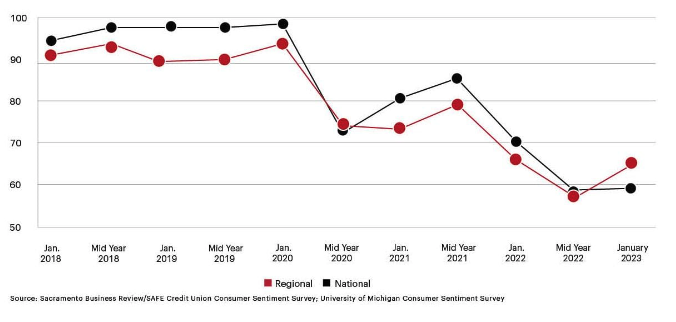
The Business Review’s consumer sentiment survey, which it conducts in partnership with SAFE Credit Union on a biannual basis, indicates that trend could continue. Fewer survey respondents plan to apply for a mortgage over the next year than ever before in the history of the survey.
And while overall consumer sentiment has improved slightly since the middle of last year, it remains lower than any other time in the last five years.
“Businesses are becoming much more cautious, and the consumer is becoming much more cautious,” Varshney said.
And consumers and businesses pulling back from spending out of fear of an upcoming downturn could, in turn, end up causing that downturn.
“We could talk ourselves into a recession,” Varshney said.
Varshney said he’s also keeping an eye on what happens with the state budget over the course of the May revision of Newsom's budget proposal and the budget's final adoption in June. Currently, the governor is planning to close the deficit largely by delaying spending and with some cuts — largely to one-time spending allocated from surplus funds last year. However, if the deficit gets deeper over spring and summer, things could get worse for Sacramento.
“We have a large number of state jobs. The last time the state went into deficit mode, we had furloughs, we had a lot of pain,” Varshney said. “We are vulnerable in that sense again moving forward.”
A different picture in the private sector
The impacts could be less pronounced in the private sector.
“We don’t expect a massive worsening of the labor market in Sacramento,” Varshney said.
He forecasts the local unemployment rate, which dropped to 2.9% last spring — the lowest it’s been for 30 years — will increase to around 4% in 2023.
“Even if we do see a recession, it should be a shallow one,” he said.
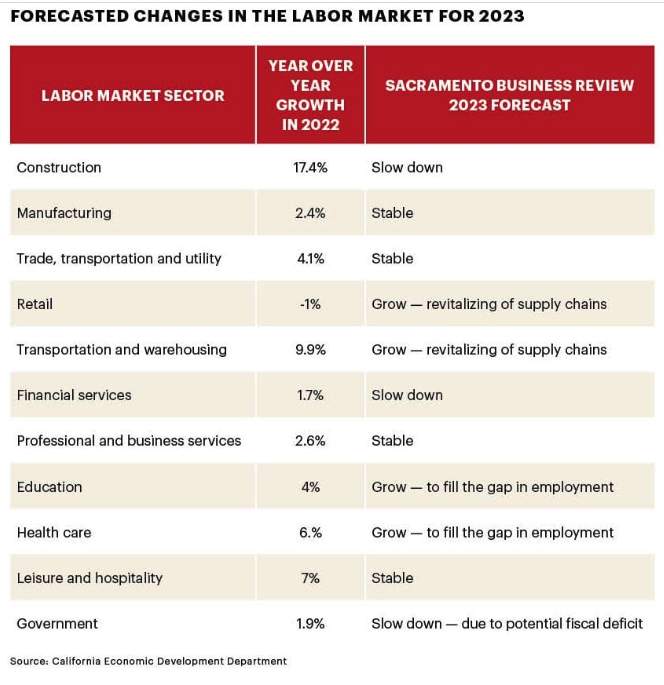
Job growth in the construction industry — which saw far and away the fastest year-over-year job growth in 2022 at 17.4% — could slow as demand for new housing declines.
The Business Review forecasts job growth in most other industries to remain stable or increase over the course of the year, as the retail and transportation sectors recover from supply chain disruptions and the education and healthcare fields try to make up for their persistent workforce shortage.
“Health care might be the bright spot for us,” Varshney said.
Down the other path, there could be more bright spots in the coming year for the Sacramento economy.
“I hope that we will not see major policy errors by the Fed or in Congress,” Varshney said.
Before the pandemic, rather than inflation, there was global deflation, and Varshney said we could be headed there again.
“The Fed might be done raising interest rates soon,” he said.
The American dollar has been weakening, which could draw more visitors to the region, especially as China reopens.
“The bright side for Sacramento, you should see tourism pick up, you should see leisure and hospitality pick up further,” Varshney said.
The current shifts in the economy could also prove to just be a rebalancing from the major disruptions over the last few years.
“Housing prices coming down does not mean it is recessionary, necessarily,” Varshney said.
He said the skyrocketing home prices over the last few years, driven by people moving from the Bay Area, were unsustainable.
“Some people probably want the housing market to continue exploding, but I think that’s a bad thing,” he said. “We want housing to continue to be affordable to the people in Sacramento.”
Varshney said that goes for human capital, too. Many of the dynamics over the last few years have been favorable to employees — who were given more job flexibility during the pandemic, and workforce shortages allowed them to demand higher wages.
Varshney said that’s swinging the other way now, with many major companies trying to increase productivity by forcing their employees back to the office.
That could prove beneficial to Downtown Sacramento, where shops and restaurants have suffered from the loss of daytime foot traffic as office employees work from home.
“If the labor market slips away back in favor of the employer, some people might view that as a negative,” Varshney said. “But I view that as a positive, because it's coming back into sync.”
If you're in the market for a home, you can trust the experienced professionals at eXp Realty of California. We are dedicated to providing superior service and expertise to help you achieve your real ....
Short sales, South Placer market trends, mortgage rates, ranch property and three featured homes.ALEX DYER | REAL ESTATEPLACER & SACRAMENTO COUNTIES · SEPTEMBER 24, 2026This week's market
Sacramento Housing Market • Distressed Property ReportSacramento Short Sales Are Rising in 2026 — Here’s What the Numbers Really ShowShort sales are showing up again nationally and
Weekly Market Report · South Placer CountyRoseville, Rocklin & Lincoln Real Estate Market ReportWeek of September 17 – 23, 2026 · Prepared by Alex Dyer, Your
Living in Placer CountySearch land and ranch listings Book a callLand & Ranch Guide, September 2026How Much Acreage Do You Need? Sizing Your Dream Ranch PropertyStart with the life you want, not
Additional:
915 Highland Pointe Dr. Ste 250Should you require assistance in navigating our website or searching for real estate, please contact our offices at 916-318-3487.
CA License # 01239383

 All measurements and all calculations of area are approximate. Information provided by Seller/Other sources, not verified by Broker. All interested persons should independently verify accuracy of information. Provided properties may or may not be listed by the office/agent presenting the information. Data maintained by MetroList© may not reflect all real estate activity in the market.
All real estate content on this site is subject to the Federal Fair Housing Act of 1968, as amended, which makes it illegal to advertise any preference, limitation or discrimination because of race, color, religion, sex, handicap, family status or national origin or an intention to make any such preference, limitation or discrimination.
MetroList CA data last updated: September 26, 2026 5:32 AM UTC Terms of Use.
Vendor data provided by Inside Real Estate, LLC.
All measurements and all calculations of area are approximate. Information provided by Seller/Other sources, not verified by Broker. All interested persons should independently verify accuracy of information. Provided properties may or may not be listed by the office/agent presenting the information. Data maintained by MetroList© may not reflect all real estate activity in the market.
All real estate content on this site is subject to the Federal Fair Housing Act of 1968, as amended, which makes it illegal to advertise any preference, limitation or discrimination because of race, color, religion, sex, handicap, family status or national origin or an intention to make any such preference, limitation or discrimination.
MetroList CA data last updated: September 26, 2026 5:32 AM UTC Terms of Use.
Vendor data provided by Inside Real Estate, LLC.
