Short sales, South Placer market trends, mortgage rates, ranch property and three featured homes.ALEX DYER | REAL ESTATEPLACER & SACRAMENTO COUNTIES · SEPTEMBER 24, 2026This week's market

Dated: January 19 2022
Views: 119
From Mark Fleming, economist with First American Title
The final Potential Home Sales Model report of 2021 revealed that market potential ended the year on a strong note. While the winter months are traditionally real estate’s slow season, our measure of the market potential for existing-home sales showed the housing market again broke with traditional seasonal patterns by ending the year strong. In December 2021, housing market potential increased 5.0 percent compared with one year ago but declined modestly on a month-over-month basis to a 6.37 million seasonally adjusted annualized rate (SAAR) of existing-home sales. The strength of the housing market is not surprising given the ongoing wave of millennial demand propelled by historically low rates and greater geographic flexibility due to work-from-home arrangements. Yet, homebuyers face a historic and worsening housing supply shortage - you can’t buy what’s not for sale.
Millennials Super-Charge Housing Market Demand
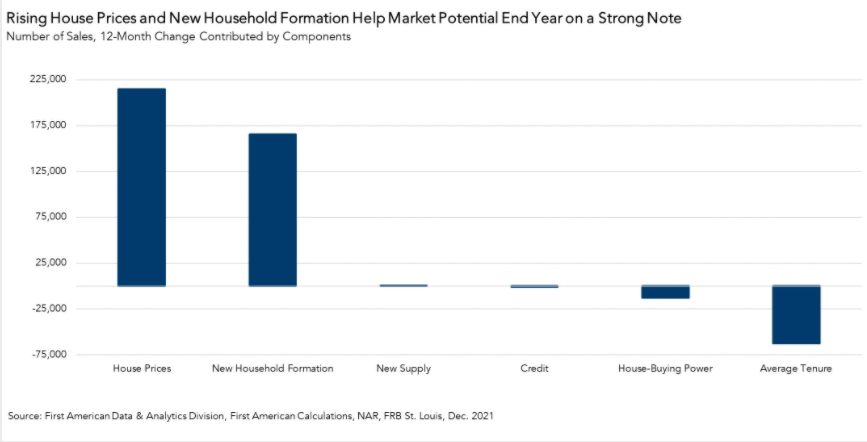
Potential home sales measures what the healthy market level of home sales should be based on economic, demographic and housing market fundamentals. One of the most consistent drivers of housing market potential over the last year has been new household formation. Millennials are the largest generation in U.S. history, and the bulk of them are aging into their prime home-buying years. New household formation, which is the new demand for housing, contributed approximately 165,000 potential home sales compared with one year ago. Even as house-buying power declined by nearly $3,000 on a year-over-year basis due to higher mortgage rates, housing demand persisted because the decision to buy a home is not strictly a financial decision but also a lifestyle decision. The challenge for new millennial households is the lack of supply, particularly at the starter home price range.
Housing Musical Chairs
Homeowners in areas where house prices are rising feel wealthier. American homeowners today enjoy record levels of equity, and as their equity grows, they are more likely to consider using that equity to purchase a larger or more attractive home – the wealth effect of rising equity. In the existing-home sales report from the National Association of Realtors (NAR) for November 2021, the increase in home sales was strongest at the upper end of the market, as sales of homes priced at more than $1 million spiked over 50 percent nationally, followed closely by homes in the $750,000 to $1 million range, which jumped 37 percent. Existing homeowners are playing “housing musical chairs” by selling to each other. In December, the growing wealth effect of rising equity caused by house price appreciation increased housing market potential by 215,000 potential home sales relative to one year ago.
You Can’t Buy What’s Not for Sale.
The dominant force holding back more housing market potential in December relative to one year ago was the lack of housing supply. Housing supply in today’s housing market remains so tight and demand so strong that in the November 2021 NAR existing home sales report, 83 percent of all homes listed for sale were sold within the month, with days on the market at 18 days, down from 21 days in November 2020. The ongoing supply shortage continues to put upward pressure on house price appreciation as buyers compete to buy what few homes are for sale. You can’t buy what’s not for sale, but you will compete for what is.
The shortage of homes for sale and the increase in house price appreciation is problematic for potential first-time homebuyers, who tend to be younger and do not have the equity from the sale of an existing home to bring to the closing table. Existing homeowners can use the equity from the sale of their current home to purchase a bigger or better home if they can find one they want. Rapid house price appreciation and its differing impact on existing and first-time homebuyers will persist until the supply and demand imbalance improves. In the game of housing musical chairs, it’s clear the housing market needs more chairs.
What Insight Does the Potential Home Sales Model Reveal?
When considering the right time to buy or sell a home, an important factor in the decision should be the market’s overall health, which is largely a function of supply and demand. Knowing how close the market is to a healthy level of activity can help consumers determine if it is a good time to buy or sell and what might happen to the market in the future. That is difficult to assess when looking at the number of homes sold at a particular point in time without understanding the health of the market at that time. Historical context is critically important. Our potential home sales model measures what we believe a healthy market level of home sales should be based on the economic, demographic, and housing market environments.
About the Potential Home Sales Model
Potential home sales measures existing-home sales, which include single-family homes, townhomes, condominiums, and co-ops on a seasonally adjusted annualized rate based on the historical relationship between existing-home sales and U.S. population demographic data, homeowner tenure, house-buying power in the U.S. economy, price trends in the U.S. housing market, and conditions in the financial market. When the actual level of existing-home sales is significantly above potential home sales, the pace of turnover is not supported by market fundamentals, and there is an increased likelihood of a market correction. Conversely, seasonally adjusted, annualized rates of actual existing-home sales below the level of potential existing-home sales indicate market turnover is underperforming the rate fundamentally supported by the current conditions. Actual seasonally adjusted annualized existing-home sales may exceed or fall short of the potential rate of sales for a variety of reasons, including non-traditional market conditions, policy constraints, and market participant behavior. Recent potential home sale estimates are subject to revision to reflect the most up-to-date information available on the economy, housing market, and financial conditions. The Potential Home Sales model is published prior to the National Association of Realtors’ Existing-Home Sales report each month.

If you're in the market for a home, you can trust the experienced professionals at eXp Realty of California. We are dedicated to providing superior service and expertise to help you achieve your real ....
Short sales, South Placer market trends, mortgage rates, ranch property and three featured homes.ALEX DYER | REAL ESTATEPLACER & SACRAMENTO COUNTIES · SEPTEMBER 24, 2026This week's market
Sacramento Housing Market • Distressed Property ReportSacramento Short Sales Are Rising in 2026 — Here’s What the Numbers Really ShowShort sales are showing up again nationally and
Weekly Market Report · South Placer CountyRoseville, Rocklin & Lincoln Real Estate Market ReportWeek of September 17 – 23, 2026 · Prepared by Alex Dyer, Your
Living in Placer CountySearch land and ranch listings Book a callLand & Ranch Guide, September 2026How Much Acreage Do You Need? Sizing Your Dream Ranch PropertyStart with the life you want, not
Additional:
915 Highland Pointe Dr. Ste 250Should you require assistance in navigating our website or searching for real estate, please contact our offices at 916-318-3487.
CA License # 01239383

 All measurements and all calculations of area are approximate. Information provided by Seller/Other sources, not verified by Broker. All interested persons should independently verify accuracy of information. Provided properties may or may not be listed by the office/agent presenting the information. Data maintained by MetroList© may not reflect all real estate activity in the market.
All real estate content on this site is subject to the Federal Fair Housing Act of 1968, as amended, which makes it illegal to advertise any preference, limitation or discrimination because of race, color, religion, sex, handicap, family status or national origin or an intention to make any such preference, limitation or discrimination.
MetroList CA data last updated: September 26, 2026 5:32 AM UTC Terms of Use.
Vendor data provided by Inside Real Estate, LLC.
All measurements and all calculations of area are approximate. Information provided by Seller/Other sources, not verified by Broker. All interested persons should independently verify accuracy of information. Provided properties may or may not be listed by the office/agent presenting the information. Data maintained by MetroList© may not reflect all real estate activity in the market.
All real estate content on this site is subject to the Federal Fair Housing Act of 1968, as amended, which makes it illegal to advertise any preference, limitation or discrimination because of race, color, religion, sex, handicap, family status or national origin or an intention to make any such preference, limitation or discrimination.
MetroList CA data last updated: September 26, 2026 5:32 AM UTC Terms of Use.
Vendor data provided by Inside Real Estate, LLC.
