Short sales, South Placer market trends, mortgage rates, ranch property and three featured homes.ALEX DYER | REAL ESTATEPLACER & SACRAMENTO COUNTIES · SEPTEMBER 24, 2026This week's market

Dated: August 4 2023
Views: 94
A state law calling for utility bills to be based on household income could drive adoption of EVs and heat pumps — or punish rooftop solar and efficiency.
Starting as soon as next year, the electric bills of a majority of Californians could be based not just on how much power they use, but also on how much money they make. That would be a nationwide first — and depending on who you ask, it could be the fairest and best way to help people adopt clean electric vehicles and heating, or an unjust and unworkable scheme that could discourage rooftop solar and energy efficiency.
An energy law passed last year in California requires state utility regulators to come up with a plan for charging customers income-based fixed fees as part of their electric bills by July 2024. The California Public Utilities Commission set last month as the deadline for interest groups to file proposals for how to create these “income-graduated fixed charges” for the 11 million customers of the state’s three big investor-owned utilities, Pacific Gas & Electric, San Diego Gas & Electric and Southern California Edison.
Based on the public feedback submitted to the CPUC by everyday customers, it’s a wildly unpopular idea. Looking into customers’ income tax records to charge them monthly fees they can’t avoid, no matter how frugal they are with electricity use or how much they invest in rooftop solar and batteries, could trigger a political backlash from customers already fed up with rates that have been rising at three times the rate of inflation and are expected to keep rising in future years.
But supporters of income-graduated fixed rates argue they’re not just a fairer way to shift the burden of paying for utility costs from lower-income customers to those better able to afford it. They’re also a way to encourage people to switch to electric heating and cooking and swap out their gasoline-powered cars for electric ones. (Opponents disagree with that claim; more on that to come.)
Here’s an important fact underlying this debate: The adoption of income-based fixed fees would not increase or reduce the total amount of money that California’s big three utilities collect from their customers. Rather, the new fixed fees would lead to some customers paying more than they do today and some paying less.
In the U.S., utilities charge their customers for how many kilowatt-hours of electricity they consume — so-called volumetric charges — and in most cases also charge them fixed fees to cover fixed costs of maintaining the grid and broader electrical system. The fixed costs — which include maintenance and expansion of distribution and transmission grids, energy-efficiency programs, low-income bill-assistance programs, and more — account for roughly half of the costs paid by customers in California.
Those costs are growing far faster than the cost of actually generating electricity, however. One of the biggest such costs in California is the billions of dollars being spent on hardening and burying power lines to reduce the risk of them sparking wildfires. Utilities are also bearing the costs of compensating the victims of wildfires caused by poorly maintained grid equipment, like the devastating 2018 Camp fire sparked by a failed PG&E power line, which ultimately drove the utility into bankruptcy protection.
Currently, the three big utilities in California have very low monthly fixed charges compared to national averages. The costs of grid maintenance and the like are incorporated into per-kilowatt-hour volumetric charges, which means those charges are high. The higher the per-kilowatt-hour prices that people have to pay for increased electricity use, the less affordable home electrification will be, fixed-charge advocates argue — and the more lower-income and disadvantaged communities may be harmed by it.
The idea of charging customers based on their annual incomes has moved from an academic proposal to an official California policy with surprising speed. It was first unveiled in 2021 by researchers at the Energy Institute at the University of California, Berkeley’s Haas School of Business. It’s unclear which state legislator added it to last year’s energy bill, AB 205. The provision was largely overshadowed by the bill’s other contentious components, such as halting the planned closure of the Diablo Canyon nuclear power plant and spending billions of dollars to bolster the grid against electricity shortfalls.
Meredith Fowlie, faculty director at the Energy Institute, argued in an April blog post that the big three California utilities’ per-kilowatt-hour prices “are too high because we’re effectively taxing grid electricity consumption to pay for costs that don’t vary with usage. […] These too-high electricity prices are slowing progress on electrification and straining the pocketbooks of lower-income households.”
Fowlie noted that her own electricity rates would go up under this proposal. “Although I don’t love the idea of sending more money to PG&E every month, I see this bill increase as a feature, not a bug, of a reform that aims to recover power system costs more efficiently and more equitably,” she wrote.
But there’s a lot of disagreement over whether a novel move to treat utility bills more like income taxes is the best way to address equity concerns and other issues.
Supporters of income-based fixed charges include the big three investor-owned utilities and the Energy Institute at Haas. Environmental groups including the Sierra Club and the Natural Resources Defense Council have traditionally opposed fixed charges, but they’ve filed fixed-charge proposals, acknowledging that the cost challenges Californians face could justify putting the concept into practice. Opponents include rooftop-solar and efficiency supporters who fear the shift could unfairly punishcustomers who invest in reducing their electricity usage, as well as anti-tax groups that have decried the proposal as a hidden tax on utility customers. Still, some of these opponents are proposing plans for new fixed charges so as to take part in the decision-making process.
Even among supporters of income-based fixed fees, there’s wide disagreement about how large they should be and which income brackets should pay how much.
The state’s three big utilities teamed up to submit a proposal to the CPUC, and it’s drawn heavy fire for the sheer scale of the fixed charges it would impose.
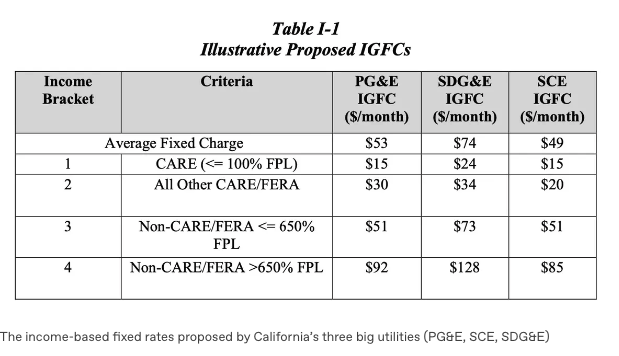
Under the joint utility plan, households with annual incomes between $28,000 and $69,000 would pay from $20 to $34 per month in fixed charges. Those earning between $69,000 and $180,000 would pay $51 to $73 per month, and those earning more than $180,000 would pay $85 to $128. Currently, the average total household electric bill in California is $164 a month.
Low-income customers who currently receive assistance to pay their electric bills would not be exempt. These California Alternate Rates for Energy (CARE) customers — whose annual earnings are at or below the federal poverty level (FPL) — would pay $15 to $24 per month in fixed fees.
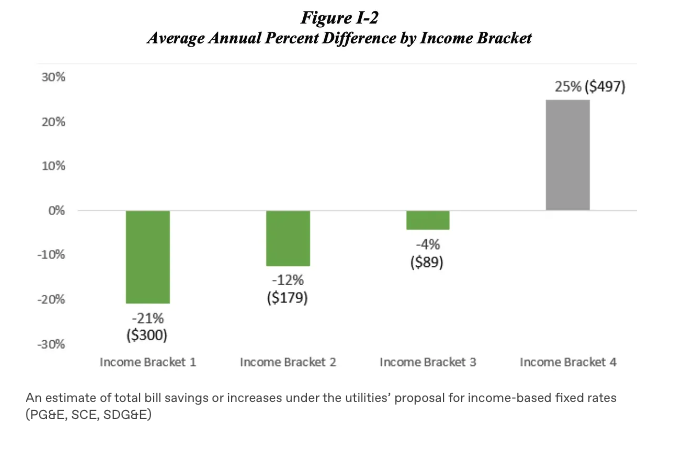
The utilities say these fixed charges would be counterbalanced with much lower per-kilowatt-hour rates on the electricity that customers consume. They forecast that most customers — all but those in the wealthiest bracket — would save money on their electric bills overall, an average of between 4 and 21 percent, or $89 to $300 per year.
“This proposal aims to help lower bills for those who need it most and improves billing transparency and predictability for all customers,” Marlene Santos, PG&E’s chief customer officer, said in an April statement.
But opponents question these utility figures. Ahmad Faruqui, an energy economist critical of the state’s recent policies on rooftop solar and utility rate design, analyzed the utility proposal and found that many customers who aren’t on CARE rates could face significantly higher bills.
What’s more, those who use the least electricity today would face the steepest cost increases under the utility proposal, he said, while those who use the most would see the largest cost declines.
“This is contrary to 40 years of energy-efficiency policies in California,” he said. “You’re going to hit a lot of customers with a penalty that is really ill-deserved.”
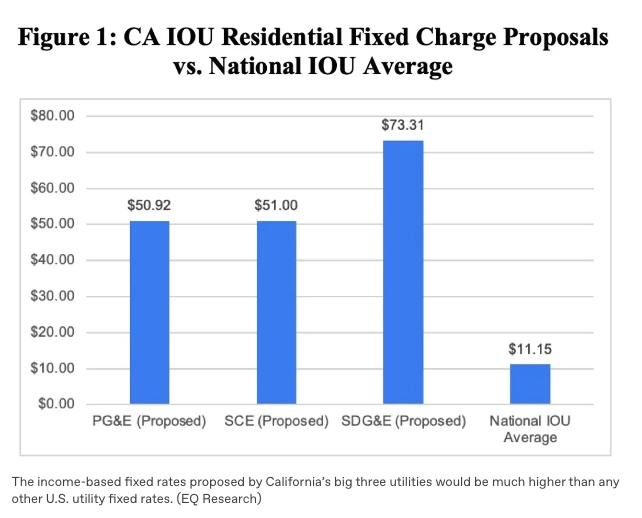
Going with the utility proposals could instantly catapult fixed charges for customers of California’s big three utilities to levels unmatched anywhere else in the country. Analysis by clean energy research firm EQ Research found that the utility plan, if enacted, would result in the nation’s highest monthly fixed fees, well above the current highest, the $37.41 monthly fixed charge levied by Mississippi Power, and nearly five to seven times the national average for utility fixed charges.
That, in turn, could lead to significant backlash from customers who aren’t able to take action to reduce their bills, Faruqui said. “Why create this huge rate shock for at least half of these 11 million customers?”
The risk of “rate shock” is top of mind for other groups that have submitted proposals for more modest income-based fixed charges. This chart from the CPUC’s Public Advocates Office, which is tasked with protecting consumers, shows the range of fixed charges that different proposals would assess on customers of varying income levels (the vertical lines on the chart) as well as the average of those fixed charges (the black box on each line).
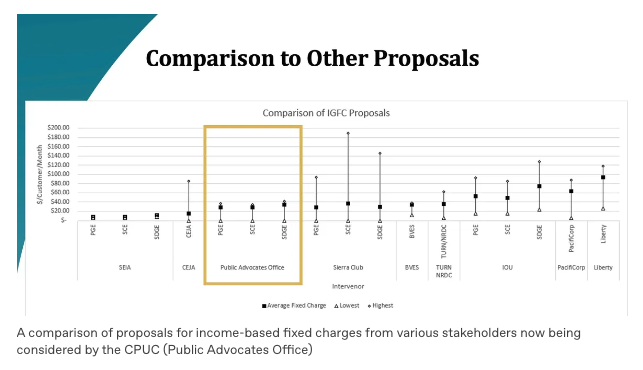
This chart shows that utilities — the three big ones plus PacifiCorp and Liberty, clustered on the right side of the chart — propose higher average charges than any other groups.
One proposal that would reduce average fixed charges by boosting charges on the highest earners comes from the Sierra Club. Rose Monahan, staff attorney at the environmental group, said the aim is to minimize harm to lower- and middle-income earners.
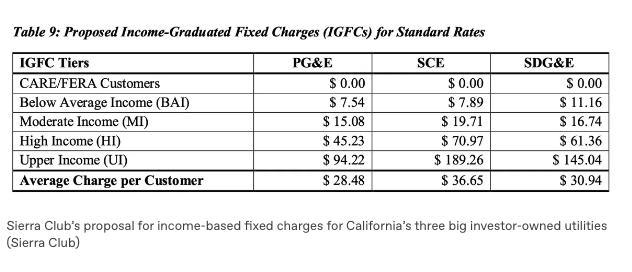
“Historically, Sierra Club has not been supportive of a fixed charge,” Monahan said. “It discourages energy conservation and efficiency, and if you have a high fixed charge, it can discourage people from investing in rooftop solar or a battery.”
Yet an income-based charge represents “a real opportunity to address historical inequities in energy rates,” she said. And “even with a volumetric rate reduction that will encourage electrification, the rates in California are still so high that people are incentivized to conserve.”
But the Sierra Club’s plan would have fixed charges cover fewer utility costs than the utilities’ proposal, Monahan said. “We have some concern with the cost components that the [investor-owned utilities] are proposing to include in a fixed charge,” Monahan said, including distribution costs, even though they’re connected to how much electricity is being consumed.
Including so many costs in fixed charges could allow utilities to argue for increasing them in their general rate cases, the proceedings that occur every three years in which utilities ask regulators for permission to raise rates or alter rate structures, she said.
Sierra Club’s fixed charges, by contrast, would include “only costs that are actually fixed,” she said, such as utility-administered efficiency programs and connecting new customers to the grid.
The Sierra Club’s plan would balance its reduced costs for lower-income earners by boosting them for higher-income earners, a structure modeled on California’s relatively progressive personal income tax, she said. While that seems fair to the Sierra Club, it does carry certain risks.
“When you get too high a fixed charge for high income, it becomes cost-effective for those folks to put a rooftop solar system on their home and batteries and just disconnect from the grid,” she said. That’s known as “grid defection,” and while it hasn’t become a significant trend yet, the higher utility rates rise, the more likely it may become one.
The risk of rate shocks, political backlash and grid defection has guided other proposals that would limit how much the highest-income earners pay.
If you're in the market for a home, you can trust the experienced professionals at eXp Realty of California. We are dedicated to providing superior service and expertise to help you achieve your real ....
Short sales, South Placer market trends, mortgage rates, ranch property and three featured homes.ALEX DYER | REAL ESTATEPLACER & SACRAMENTO COUNTIES · SEPTEMBER 24, 2026This week's market
Sacramento Housing Market • Distressed Property ReportSacramento Short Sales Are Rising in 2026 — Here’s What the Numbers Really ShowShort sales are showing up again nationally and
Weekly Market Report · South Placer CountyRoseville, Rocklin & Lincoln Real Estate Market ReportWeek of September 17 – 23, 2026 · Prepared by Alex Dyer, Your
Living in Placer CountySearch land and ranch listings Book a callLand & Ranch Guide, September 2026How Much Acreage Do You Need? Sizing Your Dream Ranch PropertyStart with the life you want, not
Additional:
915 Highland Pointe Dr. Ste 250Should you require assistance in navigating our website or searching for real estate, please contact our offices at 916-318-3487.
CA License # 01239383

 All measurements and all calculations of area are approximate. Information provided by Seller/Other sources, not verified by Broker. All interested persons should independently verify accuracy of information. Provided properties may or may not be listed by the office/agent presenting the information. Data maintained by MetroList© may not reflect all real estate activity in the market.
All real estate content on this site is subject to the Federal Fair Housing Act of 1968, as amended, which makes it illegal to advertise any preference, limitation or discrimination because of race, color, religion, sex, handicap, family status or national origin or an intention to make any such preference, limitation or discrimination.
MetroList CA data last updated: September 26, 2026 5:32 AM UTC Terms of Use.
Vendor data provided by Inside Real Estate, LLC.
All measurements and all calculations of area are approximate. Information provided by Seller/Other sources, not verified by Broker. All interested persons should independently verify accuracy of information. Provided properties may or may not be listed by the office/agent presenting the information. Data maintained by MetroList© may not reflect all real estate activity in the market.
All real estate content on this site is subject to the Federal Fair Housing Act of 1968, as amended, which makes it illegal to advertise any preference, limitation or discrimination because of race, color, religion, sex, handicap, family status or national origin or an intention to make any such preference, limitation or discrimination.
MetroList CA data last updated: September 26, 2026 5:32 AM UTC Terms of Use.
Vendor data provided by Inside Real Estate, LLC.
