Federal Reserve's Latest Rate Cut: A Delicate Balancing Act in Uncertain Times

Dated: December 12 2025

Views: 118

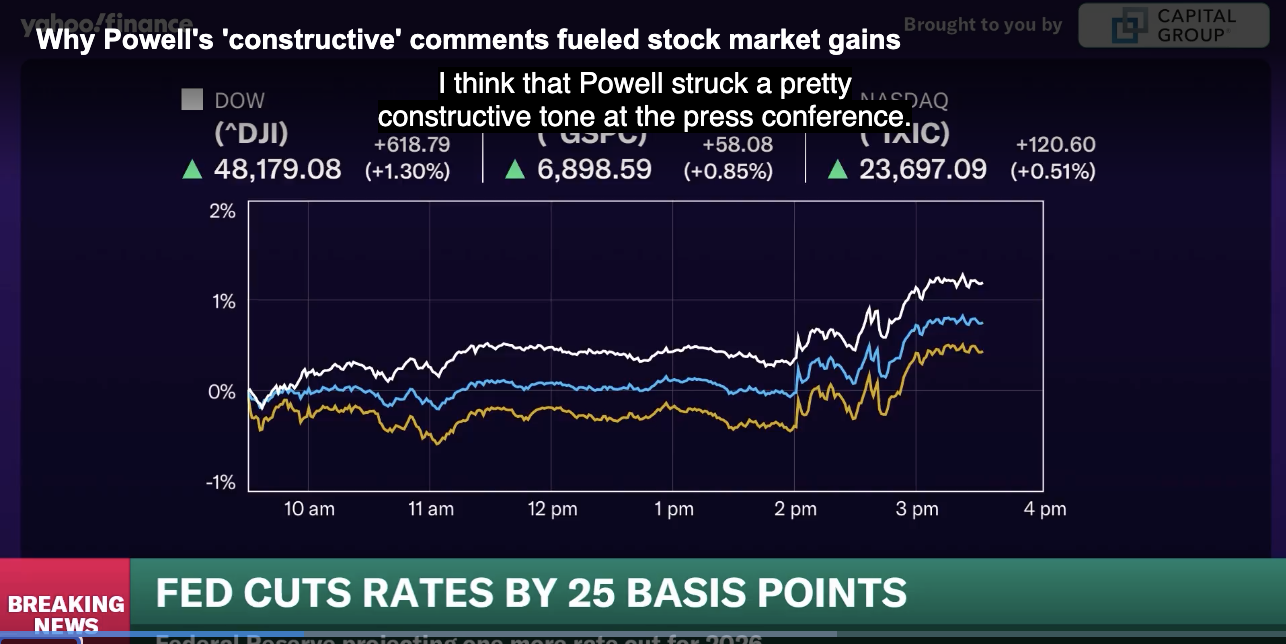
Imagine you're trying to land a plane in thick fog with two warning lights flashing—one for engine strain (inflation) and one for low fuel (jobs). That’s exactly where the Federal Reserve found itself on December 10, 2025. The outcome? A cautious 0.25% interest rate cut, the federal funds rate sliding to 3.50%–3.75%, and Jerome Powell stepping to the microphone with a sobering line: “There is no risk-free path for policy.”This wasn’t a victory lap. It was a calculated step on a tightrope strung between slowing hiring and stubbornly high prices—mostly thanks to tariffs. Here’s everything you need to know about the decision, Powell’s warnings, the markets’ reaction, and what it actually means for your money in 2026.The 0.25% Rate Cut: What Actually Happened (and Why It’s Not a Big Party)The Fed delivered its third cut of the cycle, but the mood was anything but celebratory. After a jumbo 50-basis-point slash in September and two quarter-point moves earlier, borrowing costs are now noticeably lower than the 5.25%–5.50% peak of 2023. Yet the labor market is flashing yellow: job openings are down, time-to-hire is up, and unemployment has crept higher. Meanwhile, inflation is refusing to drop cleanly back to 2%. The 25 bps cut is the Fed saying, “We’re leaning toward protecting jobs, but we’re not declaring mission accomplished on prices.”Breaking Down the New Rate Range: 3.50%–3.75%Think of the federal funds rate as the economy’s thermostat. We’ve turned it down from “roasting” to “pleasantly warm,” but it’s still well above the pre-pandemic “cozy sweater” setting of near-zero.
For everyday people, this translates to:
  • Slightly cheaper credit-card and auto-loan rates (eventually)
  • A modest drop in mortgage rates (but don’t expect 3% dreams just yet)
  • Lower yields on savings accounts and CDs (sorry, savers)
The Vote Wasn’t Unanimous—And That MattersFor the first time in a while, we saw real dissent:
  • Chicago Fed President Austan Goolsbee and Kansas City’s Jeff Schmid voted to hold rates steady (inflation hawks).
  • Trump-appointed governor Stephen Miran wanted a full 50 bps cut (dove squad).
Powell called it “respectful disagreement,” but it’s a neon sign that the committee is deeply split on how fast to ease.Jerome Powell’s Big Warning: “No Risk-Free Path”Powell’s press conference was refreshingly blunt. He essentially said: “Look, we can either risk higher unemployment or risk higher inflation—there’s no scenario where both magically fix themselves.”He also admitted the Fed is hearing loud and clear how unaffordable life feels—groceries, rent, insurance, you name it. But he reminded everyone that many of those scars are from the 2022–2023 inflation surge, not something today’s rate path can fully erase.Tariffs: The Main Culprit Behind Sticky InflationPowell pointed the finger squarely at trade policy: “Tariffs are the most significant source of the recent inflation overshoot.”
The good news? He believes the price spike is largely a one-time shift, not the start of a 1970s-style wage-price spiral. If he’s right, inflation should peak in early 2026 and then roll downhill.
Housing Affordability? The Fed Can’t Fix SupplyWhen asked about sky-high rents and home prices, Powell was painfully honest:
“A 25-basis-point move isn’t going to solve the housing problem.”
Lock-in effects, zoning laws, and years of under-building mean supply is the real bottleneck—not the cost of money.
The Fed’s 2026 Outlook: One More Cut (Maybe)The latest “dot plot” and economic projections show:
  • Only one additional rate cut penciled in for all of 2026
  • GDP growth holding steady around 2.3%
  • Core inflation peaking near 3% before drifting back toward 2.5%
Translation: The Fed is preparing to pause for a long time after one final trim.Wall Street’s Reaction: Relief Rally, Then Reality CheckMarkets initially loved the cut:
  • Dow jumped over 500 points
  • Small-cap Russell 2000 hit an all-time high
  • 10-year Treasury yield dipped to ~4.12%
But gains faded into the close as traders digested the “only one cut in 2026” message. Classic “buy the rumor, sell the news” behavior.What This Means for Your Wallet in 2026
Area
Short-Term Impact
Longer-Term Outlook
Mortgages
Slight relief, but still mid-6% range
Locked until supply improves
Credit cards & loans
Rates drift lower over months
Still elevated vs. 2021
Savings & CDs
Yields continue sliding
Shop online banks for best rates
Stocks
Supportive, but volatility ahead
Small-caps & cyclicals may outperform
Inflation
Tariff-driven peak early 2026
Should cool if no new shocks
AI, Productivity, and the Job Market: Powell’s Surprise OptimismOne fascinating nugget: Powell suggested AI-driven productivity gains could allow the economy to grow faster without reigniting inflation. He downplayed massive job displacement so far, saying companies are having trouble finding workers, not firing them. A rare bright spot in an otherwise cautious speech.Political Noise and Fed IndependencePresident-elect Trump quickly tweeted that the cut was “way too small” and should have been doubled. With Powell’s term ending in 2026 and several vacancies opening, the central bank’s independence will be tested again. For now, Powell insists decisions remain 100% data-driven.Data Delays Could Mess With January’s MeetingA lingering government shutdown threat means key October and November jobs and inflation reports might be delayed or distorted. Powell warned the Fed will “look through” noisy data—meaning January’s decision could be even more uncertain than usual.Final Takeaway: Steady Hands in Stormy WatersThe December 2025 rate cut wasn’t fireworks. It was a careful, deliberate step by a Federal Reserve that knows it’s walking a razor’s edge. Jobs are getting the slight edge over inflation fears, but no one’s pretending the road ahead is smooth.For everyday Americans, the message is simple: Relief is coming in drips, not waves. Keep your budget tight, lock in any fixed-rate debt while you can, and don’t expect the Fed to ride to the rescue on housing or grocery prices anytime soon.The economy isn’t broken, but it’s bruised—and the Fed is doing its best to nurse it back to health without creating new problems.Frequently Asked Questions1. Will mortgage rates drop below 6% in 2026?
Probably not unless we get multiple cuts or a sharp slowdown. Supply shortages and still-restrictive Fed policy will likely keep 30-year rates in the low-to-mid 6% range.
2. Should I lock in a CD now or wait?
If you see anything above 4.5%–4.75% for 6–18 months, it’s worth considering. Rates are heading lower in 2026.
3. Are we going into a recession?
The Fed doesn’t think so. Growth is expected to stay positive, and the labor market, while cooler, isn’t collapsing. Think “slowdown,” not “crash.”
4. How much are tariffs really raising prices?
Powell estimates they’ve added roughly 0.5–1% to inflation over the past year. The hit is real, but he believes most of it is already in the rear-view mirror.
5. When is the next Fed meeting that could move rates?
January 28–29, 2026. But with messy data from the shutdown, many analysts expect them to stand pat and wait for clearer signals in March.
Stay informed, stay patient, and keep your financial plan flexible—2026 is going to be another interesting ride. 🚀
Blog author image

Alex Dyer

If you're in the market for a home, you can trust the experienced professionals at eXp Realty of California. We are dedicated to providing superior service and expertise to help you achieve your real ....

Latest Blog Posts

What the headlines mean for your next move

Short sales, South Placer market trends, mortgage rates, ranch property and three featured homes.ALEX DYER | REAL ESTATEPLACER & SACRAMENTO COUNTIES · SEPTEMBER 24, 2026This week's market

Read More

Sacramento Short Sales Are Rising in 2026 — Here’s What the Numbers Really Show

Sacramento Housing Market • Distressed Property ReportSacramento Short Sales Are Rising in 2026 — Here’s What the Numbers Really ShowShort sales are showing up again nationally and

Read More

Roseville, Rocklin & Lincoln Real Estate Market Report

Weekly Market Report · South Placer CountyRoseville, Rocklin & Lincoln Real Estate Market ReportWeek of September 17 – 23, 2026  ·  Prepared by Alex Dyer, Your

Read More

How Much Acreage Do You Need? Sizing Your Dream Ranch Property

Living in Placer CountySearch land and ranch listings Book a callLand & Ranch Guide, September 2026How Much Acreage Do You Need? Sizing Your Dream Ranch PropertyStart with the life you want, not

Read More